← All our research
The research behind Beet Root & Friends
Guided by the science. Grown by nature.
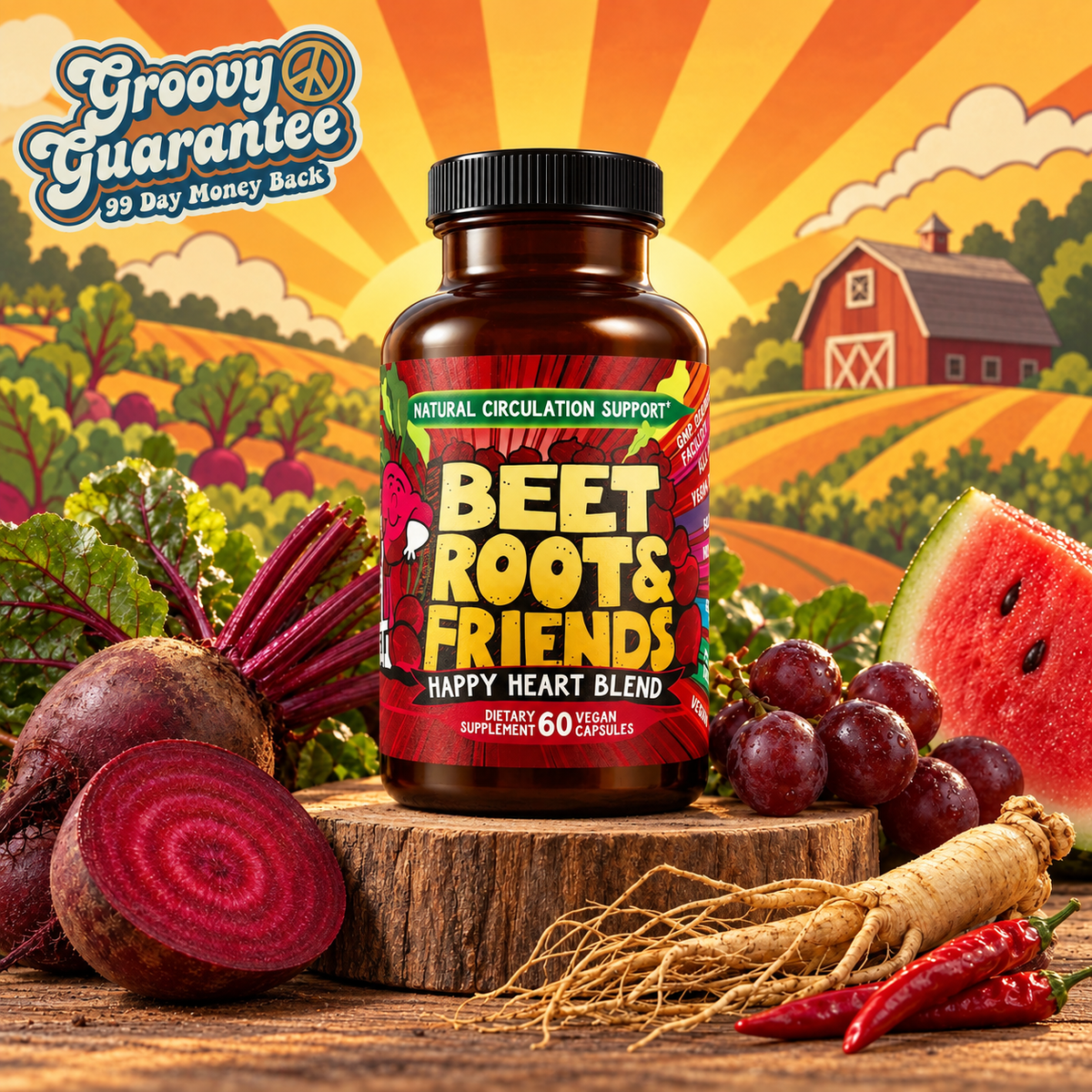
Beet Root & Friends pairs beet root with four plant friends to support healthy circulation and healthy blood pressure already within the normal range.* The research shaped how the two main ingredients go in: the beet as the whole root, and grape seed extract at an amount inside the range used across its published clinical trials.
Each study below is published and linked, with who took part, what they took, how much, for how long and what the researchers found.
Capsules, one serving (two capsules, once a day): 750 mg beet root powder · 200 mg grape seed extract · 100 mg American ginseng root · 100 mg watermelon fruit · 10 mg cayenne pepper.
Why it is built this way
The whole root
The beet goes in as whole beet root powder rather than as nitrate alone. A 2017 analysis of 22 beetroot juice trials found the gap between juice and placebo was smaller when the placebo was the same juice with its nitrate removed. The authors read that as a potential effect beyond nitrate, possibly from the beet's polyphenols.[1]
Grape seed inside its trial range
A serving carries 200 mg of grape seed extract, an amount inside the range used across published clinical trials. The 16 randomized trials pooled in a 2016 analysis used 100 to 2,000 mg a day.[2]
What the studies found
The big picture first. In 2016, researchers at Binzhou Medical University in China pooled 16 randomized, placebo-controlled trials of grape seed extract: 810 people taking 100 to 2,000 mg a day for 2 to 16 weeks.[2] Compared with placebo, systolic blood pressure came out 6.08 mmHg lower (95% confidence interval 1.42 to 10.74) and diastolic 2.80 mmHg lower. Four of the trials enrolled healthy adults. The other twelve enrolled people with prehypertension, high blood pressure, metabolic syndrome, menopausal symptoms or raised vascular risk.
Blood pressure: grape seed extract
- Binzhou Medical University, 2016, by subgroup: the effect was clearest in trials of younger adults (average age under 50), heavier adults (average BMI 25 or higher) and people with metabolic syndrome.[2]
What we say about Beet Root & Friends: it supports healthy blood pressure already within the normal range.*
Blood pressure: beetroot juice and nitrate
- Newcastle University, 2013: a pooled analysis of 16 randomized crossover trials of beetroot juice or nitrate itself, 254 adults in all, 7 to 30 per trial. Each intervention lasted between two hours and 15 days. Compared with placebo, systolic pressure was 4.4 mmHg lower (95% CI 2.8 to 5.9).[3]
- Queen Mary University of London, 2015: a four-week double-blind trial in 68 people with high blood pressure, aged 18 to 85, half of them already on blood pressure medication. They drank 250 mL of beetroot juice a day, or the same juice with the nitrate removed. In the beetroot juice group, clinic pressure fell 7.7/2.4 mmHg and 24-hour pressure 7.7/5.2 mmHg from the start of the trial, with no change on the placebo juice. In the final week, home readings were 8.1/3.8 mmHg lower than placebo.[4]
- Disclosure: the British Heart Foundation funded the Queen Mary trial, and one of its authors is a director of Heartbeet Ltd.
- Shahid Beheshti University of Medical Sciences, 2017: a review of 22 beetroot juice trials in which people drank 70 to 500 mL of juice a day for 2 to 56 days. Participants ranged from healthy volunteers to people with chronic conditions, high blood pressure among them. Systolic pressure was 3.55 mmHg lower in the juice groups than in the control groups (95% CI 2.54 to 4.55) and diastolic 1.32 mmHg lower.[1]
What we say: it supports healthy circulation and your body's natural nitric oxide production.*
Oxidative stress: grape seed extract
- Isfahan University of Medical Sciences, 2021: a review of 23 controlled trials, 19 of them pooled. Grape seed extract lowered malondialdehyde and oxidized LDL, two blood markers of oxidative stress (standardized mean differences of −1.04 and −0.44).[5]
The other ingredients
American ginseng root, 100 mg. American ginseng, native to the hardwood forests of eastern North America, is here for its calm, steady note.
Watermelon fruit, 100 mg. Watermelon is a natural source of citrulline, the amino acid studied for circulation.
Cayenne pepper, 10 mg. Cayenne adds a gentle warming touch. It has a long history in circulatory herbal traditions, and that history is why it is here.
Every product's published third-party test results are on our testing page.
See Beet Root & Friends →
Sources
Last reviewed: September 23, 2026.
- Bahadoran Z, et al. The Nitrate-Independent Blood Pressure-Lowering Effect of Beetroot Juice: A Systematic Review and Meta-Analysis. Advances in Nutrition. 2017;8(6):830-838. PubMed 29141968. doi:10.3945/an.117.016717.
- Zhang H, et al. The impact of grape seed extract treatment on blood pressure changes: A meta-analysis of 16 randomized controlled trials. Medicine. 2016;95(33):e4247. PubMed 27537554. doi:10.1097/md.0000000000004247.
- Siervo M, et al. Inorganic nitrate and beetroot juice supplementation reduces blood pressure in adults: a systematic review and meta-analysis. The Journal of Nutrition. 2013;143(6):818-826. PubMed 23596162. doi:10.3945/jn.112.170233.
- Kapil V, et al. Dietary nitrate provides sustained blood pressure lowering in hypertensive patients: a randomized, phase 2, double-blind, placebo-controlled study. Hypertension. 2015;65(2):320-327. PubMed 25421976. doi:10.1161/hypertensionaha.114.04675.
- Foshati S, Rouhani MH, Amani R. The effect of grape seed extract supplementation on oxidative stress and inflammation: A systematic review and meta-analysis of controlled trials. International Journal of Clinical Practice. 2021;75(11):e14469. PubMed 34107109. doi:10.1111/ijcp.14469.
*These statements have not been evaluated by the Food and Drug Administration. This product is not intended to diagnose, treat, cure, or prevent any disease.